A protocol, not a video course — 10 days, 15 minutes a day
The walk you dread can become the walk you look forward to
A 10-day, 15-minutes-a-day protocol that teaches a leash-reactive dog to check in with you instead of exploding at other dogs — with exact session plans for every single day. No hour-long videos. No guesswork. No shame.
Launch price — reg. $79 · 30-day money-back guarantee · Instant digital access
Safety-reviewed by Lydia Rakov, CPDT-KA, CDBC — certified professional dog trainer & behavior consultant.
If this sounds familiar
You know this walk
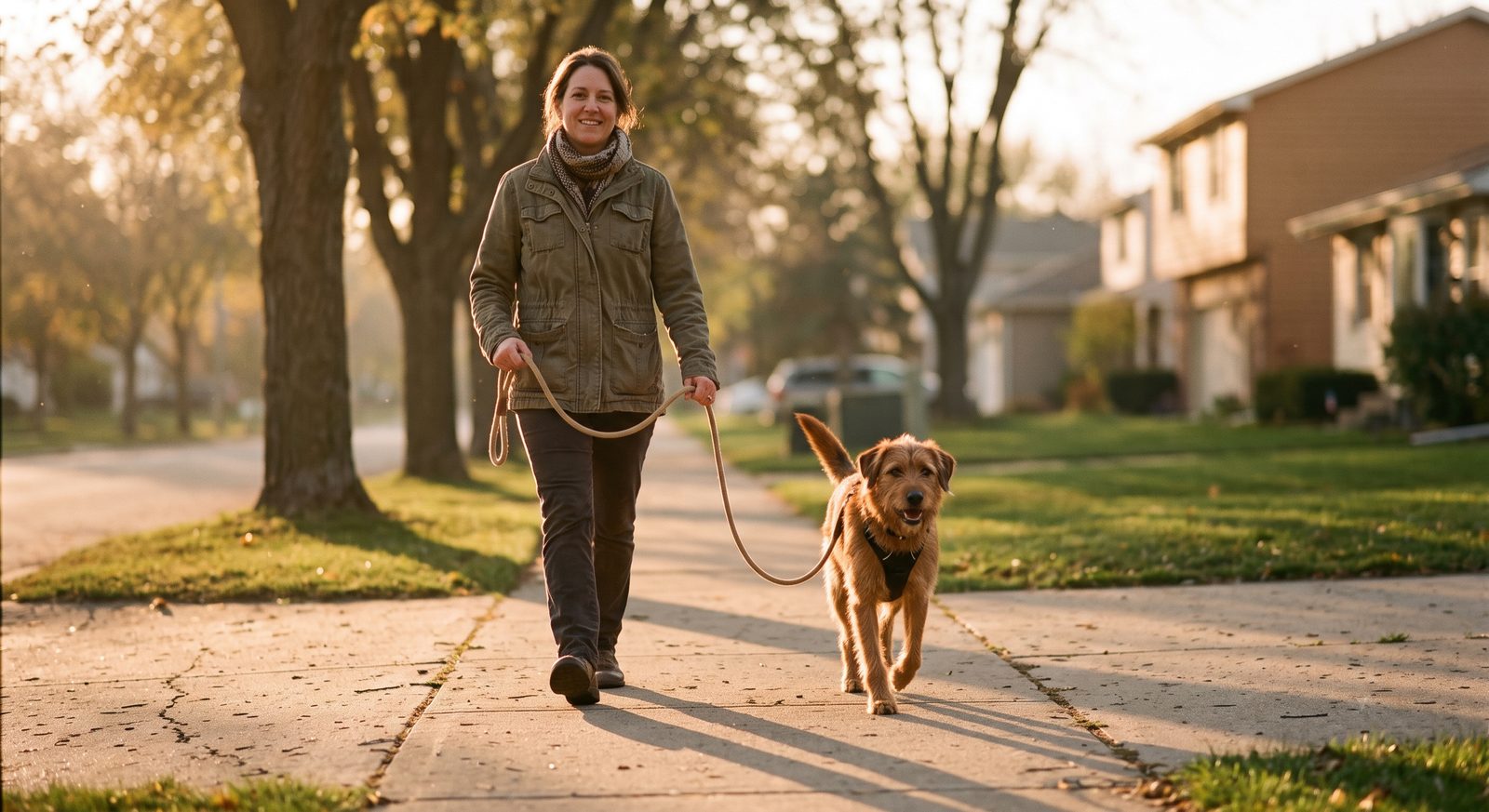
There's a dog owner who walks at 6:30 in the morning. Not because they're a morning person — because that's when the streets are empty.
They know every driveway where they can duck out of sight. They can spot another dog at 200 meters — and the moment they do, their stomach drops and their hand tightens on the leash. Which, of course, their dog feels instantly.
And then it happens anyway. The other dog rounds the corner, and their sweet, cuddly-on-the-couch dog transforms: lunging, barking, spinning at the end of the leash while the other owner crosses the street with that look. The walk home is quiet. The dog is fine two minutes later. The human isn't.
If you know this walk — the scanning, the route-planning, the apologizing — you should know two things.
First: your dog is not broken, and neither are you. Leash reactivity is one of the most common behavior issues in pet dogs, and it shows up in loving homes with dedicated owners all the time.
Second: barking and lunging on leash is, in most cases, not aggression. It's an emotional response — fear, frustration, or over-arousal — in a dog who is trapped on a leash and has no better strategy. Your dog isn't giving you a hard time. Your dog is having a hard time.
Emotional responses can be changed. There's a well-established, evidence-informed training approach for exactly this problem — it just usually gets buried inside expensive private-training packages or sprawling video courses. We turned it into a protocol.
It wasn't you
Why what you've already tried didn't work
If you've done an obedience class, taught a beautiful "sit," or tried corrections when the barking starts — and the reactivity didn't budge — that's not a failure on your part. Obedience training and reactivity work are two different disciplines: obedience teaches a dog what to do, but reactivity is about how a dog feels, and a dog over its emotional threshold physically can't access its training — the thinking part of the brain is offline.
Punishing the outburst tends to make things worse, because the dog learns "other dogs appearing = bad things happen to me," which deepens the exact negative association driving the behavior.
You didn't fail the training. The training you were given was aimed at the wrong problem.
The engine of the protocol
The method: the check-in effect
The protocol is built on two simple ideas that professional behavior trainers have used for years. You don't need a psychology degree — you need to understand two things:
Threshold: the distance where your dog can still think
Every reactive dog has a distance at which they notice another dog but can still function — sniff, eat, respond to their name. Cross that line, and no training on earth works in that moment. Training too close is the classic mistake — and it's the reason sessions stall. Day 1 of this protocol is literally mapping your dog's threshold — so every session after that happens where learning is actually possible.
Engage-disengage: turning the trigger into a cue to look at you
Instead of trying to distract your dog from other dogs (which fails the moment the distraction isn't interesting enough), you reward your dog for calmly noticing the other dog — and then for voluntarily looking back at you. Repeated correctly, at the right distance, something starts to shift: the sight of another dog can stop meaning "threat!" and start meaning "check in with my human, good things happen."
Distance is always the answer. The one-line rule the whole protocol runs on
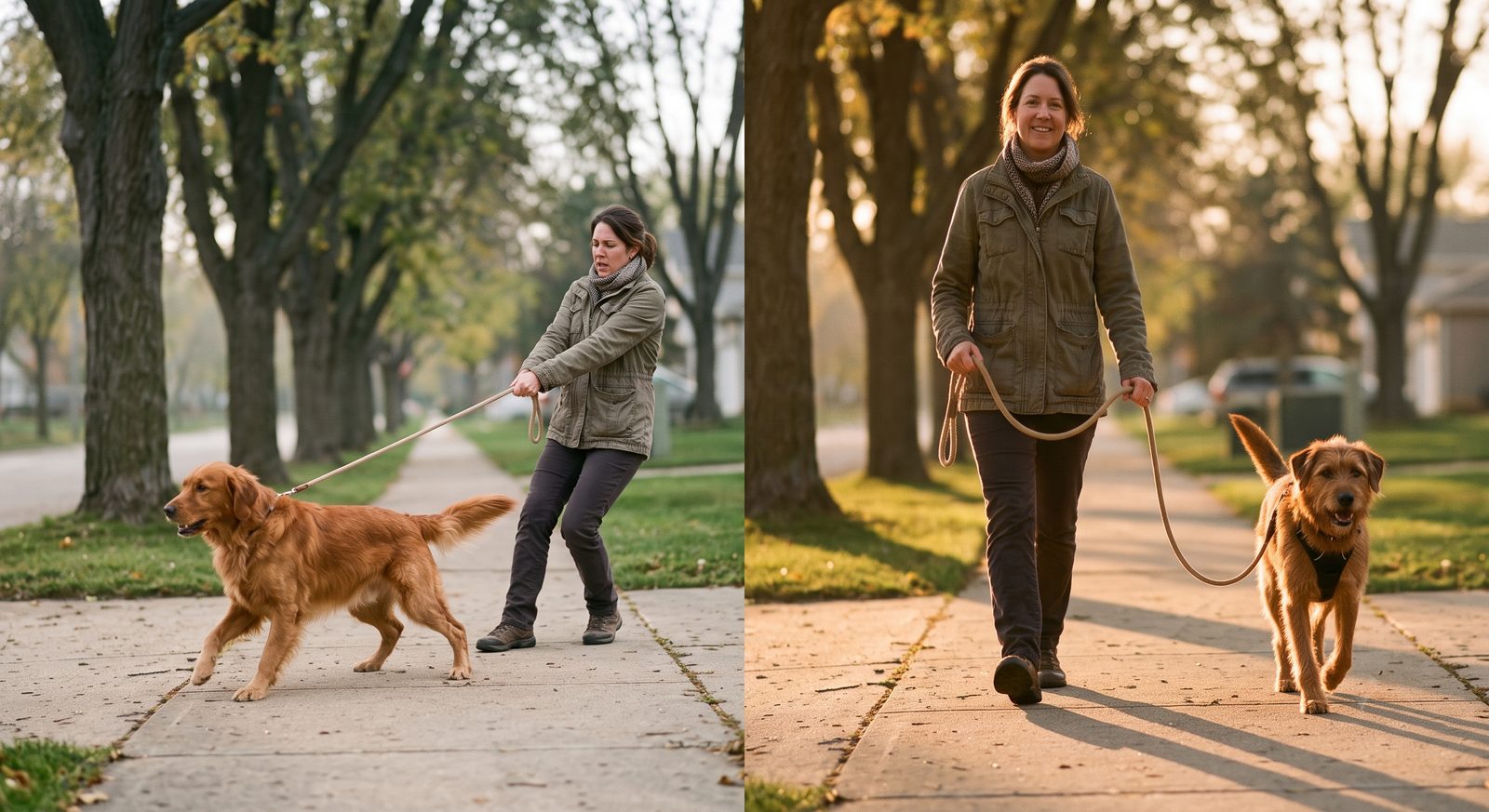
We call the result the check-in effect: the moment your dog sees a trigger and, instead of loading up to explode, turns and looks at you. That glance is the single behaviour the whole protocol is built to train.
That's it. That's the engine. The rest of the protocol is sequencing — building this one skill from a quiet room to a real walk, in steps small enough to keep your dog under what they can handle.
Over threshold vs. under threshold
The distance where training works — and where it can’t
What you get
10 days, mapped out to the session
This is not a course you watch. It's a protocol you run. Every day is a written session plan: what to do, where to stand, what to bring, what success looks like, and when to stop. About 15 minutes a day.
Start here: how this protocol works
How to use the plan, how to adapt the pace to your dog, and what "progress" actually looks like.
Module 1: why dogs explode on leash
The real mechanics of reactivity, minus the myths and the blame. Once you see what's actually happening at the end of your leash, the outbursts stop feeling personal.
Module 2: gear and setup
The simple equipment that helps (and the popular gear that quietly makes reactivity worse).
-
Day 1: Baseline + threshold mapping
Find the exact distance where your dog can still think. This one number changes everything you do afterward.
-
Day 2: The marker game: charging "yes!"
Build the communication tool the whole protocol runs on, in your living room.
-
Day 3: Engage-disengage, level 1
The session’s job: teach that looking at a trigger earns rewards, so calm observation replaces alarm.
-
Day 4: Engage-disengage, level 2: the lightbulb moment
The goal: your dog voluntarily turning back to you after spotting a trigger — the first real check-in.
-
Day 5: Your emergency toolkit
The escape moves for real life: the U-turn, the scatter, the emergency hand-target. Because the world won't wait for your dog to be ready.
-
Day 6: The observation post: your first bench session
A structured "watch the world" session at a safe distance. Passive exposure that builds calm instead of chaos.
-
Day 7: Add movement: parallel walking at a distance
Moving alongside another dog — the first taste of actually walking near a trigger.
-
Day 8: Closing distance: the 5-meter rule
The systematic way to shrink the gap while keeping your dog under threshold.
-
Day 9: Real walks: take the show on the road
Structuring an actual neighborhood walk around everything your dog has learned.
-
Day 10: Reading your progress + your maintenance plan
How to measure how far you've come, and the simple routine that keeps it.

The protocol, the field cards, and the mobile edition — everything is yours to keep. Lifetime access, all future updates included.
Plus: the troubleshooting encyclopedia
When Training Hits a Wall: my dog won't take treats outside, we regressed after one bad encounter, off-leash dogs keep charging us, progress stalled at Day X, my dog is fine with some dogs but not others… Look up your exact wall, get the exact next step.
Plus: the FAQ module
Straight answers to the questions everyone asks (harness or collar, what if I have two dogs, what about the neighbor's fence-fighter, and more).
Instant digital delivery. Readable on any device.
The field kit
6 printables, designed to be used on the walk
Not filed in a drawer — clipped to you, on the sidewalk, one hand on the leash.
Threshold map
Chart your dog's distances so you always know where training works.
Session log
2 minutes after each session; makes progress visible when day-to-day feels slow.
Walk cheat card
Pocket-sized "what do I do right now" card for mid-walk moments.
Decision tree
Dog appears: train, manage, or leave? One glance, one answer.
Progress tracker
The trendline view that keeps you going through wobbly days.
Gear checklist
Everything to grab before you walk out the door.
Honest scope
Who this is for — and who it isn't for
An honest product has edges. Here are ours.
The SteadyWalk Protocol is for you if:
- Your dog barks, lunges, whines, or pulls hard at the sight of other dogs (or people/bikes — the method transfers) on leash
- Your dog is otherwise friendly or neutral at home — the problem lives on the walk
- You can commit ~15 minutes a day for 10 days (they don't have to be consecutive)
- You want a plan, not a philosophy lecture
This is NOT for you if:
- Your dog has bitten a person or dog, or you believe your dog would if able to reach them. That's beyond leash reactivity, and beyond what any self-guided product should claim to fix. Please work with a certified behavior professional (a veterinary behaviorist or a credentialed behavior consultant) in person. A case like that needs to start there: this protocol is not a substitute for that hands-on help, and not a companion to it.
- You're looking for a fix that requires zero practice. The sessions are short, but they're real.
- Your dog's issues are primarily inside the home (guarding, separation distress). Different problems, different protocols.
If you're in the "not for you" group, please don't buy this. We'd rather lose a sale than waste your time or your dog's.
One payment, lifetime access
Get the full protocol
The regular price of The SteadyWalk Protocol is $79. During launch, it's $39 — that's the entire discount story, no fake math, no "$500 value" theater. One payment, lifetime access.
Here's everything included:
- The full 10-Day SteadyWalk Protocol — every session planned out step by step
- Start Here guide + Why Dogs Explode + Gear and Setup modules
- All 6 field printables (Threshold Map, Session Log, Walk Cheat Card, Decision Tree, Progress Tracker, Gear Checklist)
- The Troubleshooting Encyclopedia
- The FAQ module
- Lifetime access + all future updates
- 30-day money-back guarantee
For less than the cost of a single private training session, you get the same underlying method — sequenced, written down, and ready to run tomorrow morning.
Get the SteadyWalk Protocol — $39Our 30-day guarantee — in plain words
Try the full protocol. If within 30 days you feel it wasn't worth what you paid — for any reason — email us at hello@getsteadywalk.com and we'll refund you in full. No forms, no "prove you did the homework," no hassle.
One honest note: we can't guarantee your dog will be transformed in 10 days, and you should be suspicious of anyone who does. Dogs are individuals; some fly through this protocol, some need to repeat days, and that's normal (the protocol tells you exactly how to handle both). What we can guarantee is your money back if you're not satisfied. The risk is ours.
Our no-fake-reviews policy
Why there are no testimonials here (yet)
No testimonials here yet — on purpose.
The SteadyWalk Protocol has just launched, and we only publish reviews from real owners with real dogs. As the first cohort finishes their 10 days, their words will appear here — names, dogs, breeds and all. Until then, the 30-day guarantee above carries the risk, not you.
What this page does have today: the full protocol was safety-reviewed by Lydia Rakov, CPDT-KA, CDBC — a certified professional dog trainer and behavior consultant — before launch.
Straight answers
Frequently asked questions
How much time does this really take?
About 15 minutes a day of active training, plus reading each day's short plan (5–10 minutes). Sessions are deliberately short — you stop while your dog is still succeeding, which is the point.
What if my dog needs more than 10 days?
Then take more than 10 days — the protocol explicitly plans for it. The days are stages, not deadlines. Many dogs repeat Day 3–4 or Day 8 a few times, and the plan tells you exactly when to repeat, when to move on, and when to drop back a level. There's no falling behind, because there's no schedule to fall behind on.
Is this for aggressive dogs?
No — and we want to be straight with you about that. If your dog has bitten, or you believe they genuinely intend to harm another dog or person, please work with a certified professional (veterinary behaviorist or credentialed behavior consultant) in person. This protocol is for leash reactivity — barking and lunging driven by fear, frustration, or over-arousal — which is most of what owners are dealing with, but not all of it. When in doubt, ask a professional first. For a dog with a bite history, that professional work is the starting point — not something this protocol runs alongside.
My dog reacts to people or bikes, not just dogs. Will this work?
Yes. The method — threshold work plus engage-disengage — is trigger-agnostic. The protocol is written with dog-triggers as the main example because they're most common, and it shows you how to swap in your dog's specific trigger.
Is this all video? I don't have time for a video course.
The opposite — that's the point. This is a written protocol with session plans and printable field cards you take on the walk. You can read a whole day's plan in the time it takes a video course to finish its intro. Nothing to binge, nothing to rewatch at 2x speed.
My dog won't take treats when another dog is around. Won't that break the whole method?
A dog refusing food is a dog over threshold — it's information, not a dead end. Day 1's threshold mapping exists precisely to find the distance where your dog can take treats, and the Troubleshooting Encyclopedia has a full entry on food refusal, including what to do for genuinely low-food-drive dogs.
What equipment do I need? Do I need a special collar?
A standard harness, a fixed-length leash, and treats your dog loves. Module 2 covers the details — including why we don't use prong collars, e-collars, or retractable leashes, and what to use instead. Nothing expensive.
How is this delivered, and what if it doesn't work for us?
Instantly, as a digital product (readable on any device, printables as PDFs), with lifetime access and free updates. And it's covered by the 30-day money-back guarantee above: if you're not satisfied, one email to hello@getsteadywalk.com gets you a full refund.
Ten days from now
The next walk is up to you
Somewhere in your neighborhood tomorrow morning, another dog is going to round a corner.
You can meet that moment the way you always have — breath held, leash tight, hoping.
Or, ten days from now, you can meet it with a plan: knowing your dog's threshold, knowing exactly what to do — and training toward the moment your dog sees the trigger… and turns to look at you.
That check-in is trainable. This is the protocol that trains it.
Launch price, reg. $79 · 30-day money-back guarantee · Lifetime access · 15 minutes a day